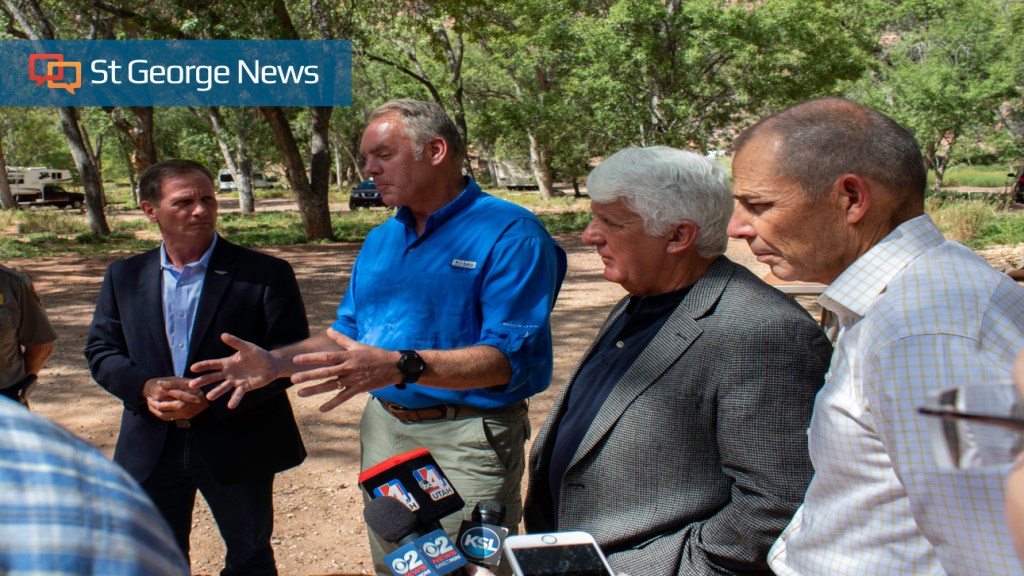
ZION NATIONAL PARK — Secretary of the Interior Ryan Zinke, along with three Utah congressmen, visited Zion National Park Monday to address the nearly $16 billion in deferred maintenance backlog across national parks, public lands and fish and wildlife services.

Rep. Rob Bishop, R-Utah, is sponsoring a bipartisan bill, H.R. 6510, Restore Our Parks and Public Lands Act of 2018, along with co-sponsors Rep. John Curtis, R-Utah, and Rep. Chris Stewart, R-Utah.
Rep. Mia Love, R-Utah, also is a co-sponsor, but did not attend the Zion event.
The bill would allocate federal energy revenue to pay for the deferred maintenance backlog for things like road and facility upkeep as well as issues related to public health and visitor safety.
“The experience in the parks should be first class,” Zinke said. “The park experience is what we all hold sacred, and to do that we need to make sure the infrastructure, the facilities, reflect that pledge.”
Some $12 billion of the deferred maintenance is from national parks, and $1.3 billion is backlog from the wildlife refuges, he said. The remainder is related to other public lands, such as the Bureau of Land Management, and Native American education.
Utah’s’ maintenance backlog totals about $260 million, with Zion accounting for about $65 million of that.
About half of the backlog is because of roads, Zinke said. And not all of the roads are on park property. Approximately one-third of them are gateway roads allowing access to the park that the park service is responsible for maintaining.
Stewart attributed the increase to a cultural shift, not a larger population
Much of the wear on parks is due to years of visitor use, which has been increasing. About 330 million people visited national parks last year, 10.5 million visitors in Utah. Stewart attributed the increase to a cultural shift, not a larger population, as younger generations are becoming more interested in the outdoors.
By investing in upkeep and upgrades, the parks will be able to accommodate more people and provide a better experience, without having to restrict the number of people who can enter the park, Stewart said, adding “We think that’s the worst choice.”
Being able to accommodate the increasing number of visitors is one of the reasons Stewart said he proposed a bill to turn Grand Staircase-Escalante National Monument into Utah’s sixth national park.
Read more: Stewart proposes creation of new national park
Deferring maintenance ends up costing more than performing the maintenance in a timely way, Curtis said. The cost of deferred maintenance increases 2 percent annually. Not only would the bill save money but would contribute to visitor safety and a good park experience.
Quality of life matters. And nothing brings quality of life like these national parks
“Quality of life matters. And nothing brings quality of life like these national parks,” Curtis said. “Preserving and protecting them is paramount to the life that we enjoy here in the United States.”
The funds would come from all sources of federal energy revenue, including natural energy sources like wind and solar, as well as fossil fuels sourced in the U.S., Zinke said.
“If you’re producing energy on public lands, I think you also have an obligation to make sure public lands are maintained, are in good shape for generations to come.”

The bill is also designed to pay for deferred maintenance without raising taxes or increasing government, Bishop said. The money that would be allocated is currently going to general funds in the U.S. Treasury.
The bill is constructed so that deposits to the fund are authorized for five years and are capped at $1.3 billion annually so that park projects are guaranteed enough money to be completed, he said.
Not only would the bill help pay for national parks and public lands, but it would go toward improving facilities for the Bureau of Indian Education.
“They deserve a world-class education, too. And if you look at some of the facilities, they’re shameful,” Zinke said.
In Zion, 42 percent of the backlog is due to roads, parking and tunnels; 31 percent for buildings; 11 percent for maintaining landscapes, 9 percent for trail and bridges upkeep; 5 percent for water and wastewater systems; and 2 percent for other issues Superintendent Jeff Bradybaugh said.
Zion officials are specifically concerned with visitor safety and experience. Roads, transportation, building upkeep and maintaining trails are considered top priority, Bradybaugh said. Some of the park facilities were built decades ago and are not up to code for accessibility, water or electric.
The longer we defer these projects, the more expensive they become.
“The longer we defer these projects, the more expensive they become.”
Zion officials have plans for upkeep in the park, but are looking to not only maintain but improve the park and visitor experience by working with both government and nonprofit organizations like the Zion Forever Project.
Read more: Zion Forever Project releases plans for protecting, improving Southern Utah parks
One long-term proposal is to rehabilitate the South campground. The Watchman campground was renovated to provide upgraded facilities, new, larger restrooms and better camping spots, Zion facility operations specialist Treacy Stone said.
Zinke, Bishop, Stewart and Curtis, along with several local elected officials, visited both campgrounds to see the difference firsthand.

The South campground project would redesign the road to make it easier to navigate, build three new restrooms and restore the historic restroom, add a picnic area with 15 sites, replace utility lines and make the entire campground more accessible. The project will cost almost $8 million and is planned to be constructed in 2022.
Vince and Thary Boling, along with their 1-year-old daughter Elianna from Graton, California, spent one night in the Watchman campground before spending their second night in the South campground.
“We were surrounded by the same beauty, however, there’s some safety concerns for her just around our campground. It’s not as well maintained, obviously, the bathrooms are nowhere near as nice,” Vince Boling said.
If the bill is passed, distribution of funds has already been prioritized based on public safety, environmental compliance and public health. Zinke is confident that the bipartisan bill will pass.
“Parks are not a Republican or Democrat issue. Parks are an American issue,” Zinke said.
View original post here.
 Mikayla Blair
Leave a comment