
The first day of Matthew Wangeman’s life was a rough one. With his umbilical cord wrapped around his neck, he could not breathe. Then, he spent six weeks in the hospital, and it was uncertain if he would survive, yet he did.
At 18 months, Wangeman was diagnosed with Cerebral Palsy (CP), a neurological disorder caused by a lack of oxygen to the brain. CP usually occurs while a child’s brain is developing around the time of birth and can affect the individual’s motor skills, body movement and speaking abilities.
When Wangeman was 2 years old, his father passed away, and his mother was left to care for two children, one with a significant disability. Wangeman was then sent to Anne Carlsen Center, a residential school for children with disabilities. He could have stayed at the institution his entire life, but Wangeman decided he wanted more for himself.
He attended a high school in North Dakota for students with disabilities, where he graduated as valedictorian of a class of six. He always knew he wanted to go to college, so he attended University of California, Berkeley where he earned a bachelor’s degree in business and a master’s degree in city planning.

Wangeman does not let his disability hold him back. Wangeman has been a professor in disability studies at NAU for nine years. He co-teaches an introduction to disability studies class and two senior capstone classes for the disability studies minor with Katherine Mahosky, NAU professor who co-teaches with Wangeman.
Wangeman loves football and is also a part of the NAU football team. He attends their practices and events and speaks in front of the team every year. Head coach Jerome Souers calls Wangeman an honorary coach.
“I do that because I do love football, but those guys are probably the most scared about disability. So I think with me being around them, they will get less scared about disability,” said Wangeman.
Wangeman is working to change the negative stigma that is often associated toward people with disabilities.
“I don’t think disability is a bad thing, it is just different. And what makes it bad is the attitudes that other people have about disability,” Wangeman said.
Wangeman believes it is society that puts negativity on disabilities.
“Many people ask me if there was a pill to make me not how I am, would I take it? I say no because I like who I am. And if you ask people who know me, I am probably the happiest person they know,” Wangeman said.
Wangeman has a 14-year-old son, Elijah, who he describes as “just brilliant.” Wangeman and his son are in a six-minute documentary, My Dad Matthew, which premieres Thursday, Feb. 23. The short film is about disability advocacy and the relationship that Wangeman and his son share.
“About a year ago, John Schaffer, who I have known for about 10 years, said ‘Matthew, would you like to finally make a movie with me about your life, because he is a filmmaker, and I have been kind of on him to make a movie,” Wangeman said.
Schaffer received a grant to make the film from One-Revolution, an organization that gives grants to people to make short films about disability through their “Upside Down Program.” The idea is to make films to help change the perceptions people have about disability.
“To me, disability is just part of the great diversity in this world,” Wangeman said.
My Dad Matthew will be shown at the NAU Cline Library Assembly Hall from 7 p.m. to 8:30 p.m. Admission is free, and Wangeman and his son will lead a discussion afterward. The event will also be streamed live on Facebook through Wild Asparagus Productions.
“My hope for this documentary is that it makes people stop and think about disability,” Wangeman said.
Wangeman has been an advocate for people with disabilities for about 30 years.
“People with disabilities sometimes get down because this society is not very good at including people with disabilities. So people with disabilities have to believe in themselves,” Wangeman said.
Wangeman has staff who assist him with several things. His main staff member and personal assistant is Kelly Hurlbut.
Hurlbut helps Wangeman get around in his wheelchair and re-voices for him. Re-voicing is the process of reading aloud the things Wangeman says. Wangeman communicates by using a printed keyboard that also includes commonly used words. He wears a helmet with a pointer attached to it, spells out things that he wants to say, and Hurlbut says them aloud.
Hurlbut has worked with Wangeman for about four years, but they’ve known each other for nearly 10 years.
“I was his staff a long time ago, and I knew his kid when he was super little. And he was still a little smarty pants way back then. Great kid, though. I went on a couple trips with him when I started, and well, we got along,” said Hurlbut.
The two of them go on trips a couple of times each year where Wangeman speaks at conferences.
“Hopefully, because of his mini-documentary coming out, he might get more speaking opportunities, and I know he would very much like to do that,” Hurlbut said.
Mahosky has a degree in speech pathology and a doctorate in education curriculum and correction and helps Wangeman teach.
“I may lead off on a lecture — we just really have this nice kind of flow. If he adds in, I kind of look over when I know he wants to talk about something in particular, but we’re also plan-full. I may say to him, ‘Next week, I really need you to talk about, you know, living in institutions,’” said Mahosky.
Working as a team has been very beneficial to both Wangeman and Mahosky, as well as the students taking their classes, she said.
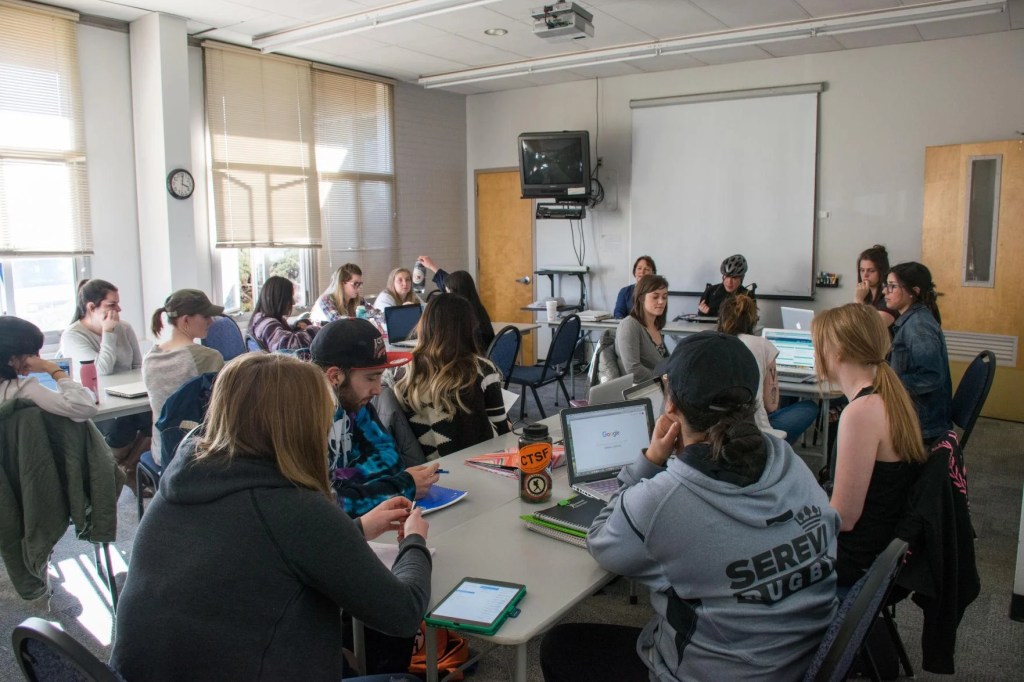
“We have different perspectives. In a way, my training was certainly as a speech pathologist. Learning about what his preferred choices are, that’s a perspective we don’t always get in our training. I often tell the students that I’ve really had sort of an awakening or such about how I might think about communication disorders and working with individuals. So I think that’s been advantageous for both of us to have. I don’t have a disability. I can’t really voice that experience, and I think that’s extremely valuable in this class. It keeps us authentic,” Mahosky said.
Hurlbut has also noticed having Wangeman in the classroom has changed students’ perspectives.
“I know at one time they did a filming when Matthew was doing his one-on-one. They quoted it, and the ones who continued in the minor, they asked him at the very end some other questions, and it was incredible the difference just in their perspectives and attitudes about disability,” Hurlbut said.
Disability is still very much unknown, and Wangeman intends to change that. Whether it’s through teaching, speaking at conferences or making short films, Wangeman continues to change the perspectives people have about disability.
View original post here.
 Mikayla Blair
Leave a comment