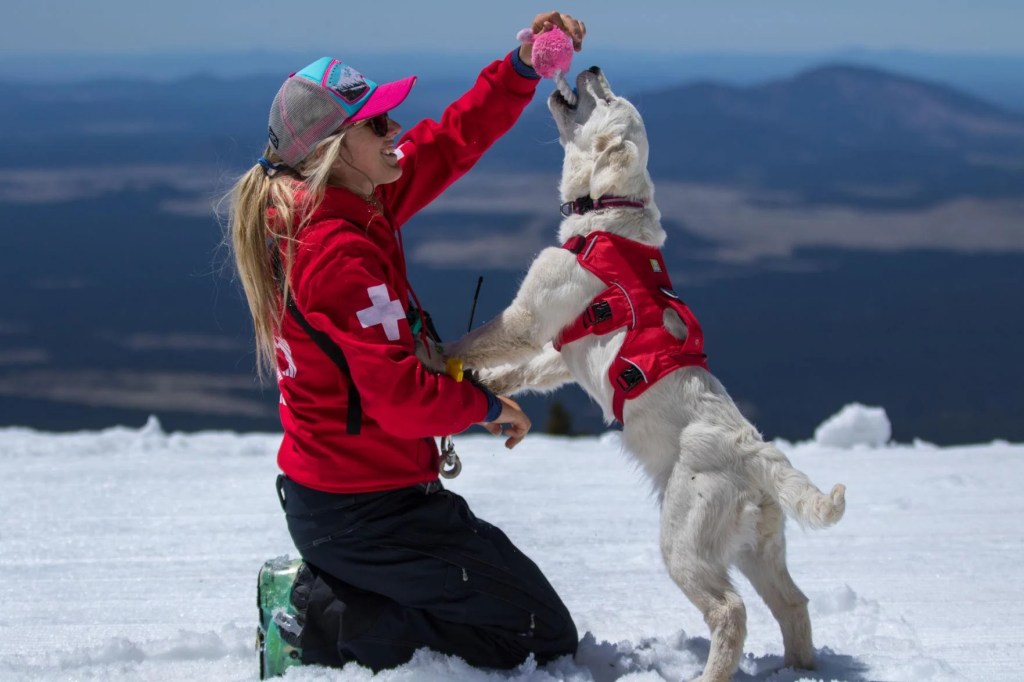
A steep slope, unstable snow and some sort of trigger is all it takes to bring a huge sea of snow crashing down a mountainside. Avalanches are not uncommon up in the mountains, and Arizona Snowbowl is preparing by training its first avalanche dog, or avy dog, a puppy named Ava.
Ava is a 4-month-old English cream golden retriever. She came from a litter of eight puppies in Salt Lake City. Avalanche dogs are chosen based on how well they do in a series of aptitude tests. Some of the tests the puppies go through include having the puppy give a person a kiss or dropping an object next to the puppy to make sure the puppy is not bothered by loud sounds.

“[Ava] tested with mostly 3s and 4s [out of 5], so that means she’s going to be a really easy dog to train at first, which has definitely been the case. She’s very mellow and an easy dog for me to train. She’s been awesome for everybody up there,” said Hailey Hagerty, ski patroller and avalanche dog handler at Arizona Snowbowl.
Hagerty is also a senior public health major at NAU. She worked with both Snowbowl and NAU to allow her to start an avalanche-dog program as an internship to complete her degree. This is Hagerty’s fourth season working at Snowbowl.
“We got [Ava] up there because it would be good public education, teaching about skier safety, snowboarding and avalanche hazards,” Hagerty said. “Also having her be, when she’s all trained up, a rescue resource for us. So it’s a pretty awesome internship.”
Snowbowl has avalanches every year, but how many they have depends on the snowpack and the weather. According to the National Avalanche Center’s website, snow is layered in most mountain snowpacks. The danger comes when unstable snow is underneath a stronger and more cohesive slab of snow.

Snowbowl sits at the beginning of most avalanches. Beyond Snowbowl, the inner basin is also an avalanche hazard because it is covered in slide paths. While there are many avalanches, it has been a long time since someone has been caught in one at Snowbowl.
Once Ava has completed her basic training, the goal is for her to be a resource for both Snowbowl and the surrounding area if someone is caught in an avalanche.
Ava is also Hagerty’s pet, and she spends at least 60 hours per week training with her. Training for avy dogs includes extensive obedience training and mock rescue training. Searching games like hide-and-seek, hiding in snow caves and tug-of-war are also a major part of early training for avy dogs.
“I just make it the most exciting game in the world for her, and play tug-of-war and give her treats,” Hagerty said. “Then, repeatedly, we make it harder and harder for her. Eventually she’ll really see it as a game and then be able to find people buried under snow.”
Avalanche dogs are able to find people buried deep under snow by practicing searching for faint human scents under the snow. Training includes the handler hiding in snow caves or burning clothing, and when the dog finds the source of the scent, they are rewarded with treats or playing a game of tug-of-war.
Eventually the dog begins to associate the human scent under the snowpack with a reward. Contrary to popular belief, the dogs do not need an article of clothing to find a person. The dogs associate all human scent with a reward and can find anybody without having previously smelled a person’s particular scent.
Avy dogs also need to be accustomed to distractions in their environment. They cannot be bothered by chaos from skiers, snowboarders or scents, and they have to be comfortable riding the chairlift to the top of the mountain. Ava is working on these skills and can check riding the chairlift off her training list.
“She really likes the chairlift rides right now,” Hagerty said. “She’ll take nice naps in the morning and everything.”
Eventually Snowbowl hopes to expand its avalanche dog program. For now, it is focusing on learning more about avy dog programs from books, classes and experienced handlers.
Avalanche dogs have a primary handler, but they also have a secondary handler who helps out with the dog and can take them to work if the primary handler is not available.
While Snowbowl wants to be prepared for rescuing people from avalanches, its main goal is to prevent these accidents altogether. Preventing accidents is one of the main jobs of a ski patroller.
“Your first priority is mountain safety,” said Ed Rudd, ski patroller at Snowbowl. “You want to make sure you know the mountain’s safe for all the general public up on the hill, and if somebody gets hurt or injured, we render first aid. We get them down to the bottom of the mountain where we can get them transported if need be to higher-level care.”
Rudd has been a ski patroller at Snowbowl off and on for 18 years. He is also a paramedic for Flagstaff Medical Center and a flight nurse for Guardian Air.
Rudd said one of the biggest dangers at Snowbowl is skiers and snowboarders not following the rules. It is important for people on the mountain to wear helmets, go with a buddy and watch out for each other to avoid collisions. Accidents happen frequently at Snowbowl, and depending on the day, it can range from five to 30 accidents.
“Not only is it always good to have a buddy in case something does happen — you have somebody to help you out or to go get help — it’s also fun skiing with a buddy,” Rudd said.
Many ski resorts have avalanche dogs, including Crystal Mountain Resort in the Mount Baker-Snoqualmie National Forest in Washington. Crystal Mountain is also dedicated to preventing accidents.
“The role of the ski patroller is a busy one. There are lot’s of different hats within that. We’re avalanche mitigators. We will go out in the early morning and intentionally set off avalanches so that [the] risk hopefully is reduced for when there are skiers on the slope,” said Sara Cohen, professional ski patroller and manager of the Crystal Mountain Avalanche Rescue Dogs program at Crystal Mountain Resort.
Crystal Mountain currently has five active avalanche dogs. Avalanche dogs are able to work for about 10 years before retirement. The resort prepares for the retirement of dogs and trains new puppies in advance so they will be ready to work when another dog retires.
At Crystal Mountain, snow is present all year long. However, the dogs do enjoy different kinds of training during the summer such as hiking, swimming and running to stay conditioned for the winter.
Depending on the size of the avalanche, either a one-dog team or multiple-dog team will respond. Usually the dogs are responding to a call when they are certain someone has been caught in an avalanche and is likely deceased. The dogs are able to locate the person who was buried and find out if anyone else was involved in the accident. The dogs are also used to find victims if patrollers are unsure if someone has been caught in an avalanche.

The dogs typically work for an hour before they need a break. A dog’s nose starts to get tired, and the dogs needs time to rehydrate and rest their mind. Cohen said it is also a good practice to bring a different dog to an avalanche scene to ensure no one is buried.
Safety for avalanche dogs is a major concern at both Crystal Mountain and Snowbowl. Dogs must be properly cared for so they can adequately perform their jobs.
“A dog that knows how to travel safely will prevent both the dog and the handler from getting injured trying to move the dog around on the hill,” Cohen said.
Crystal Mountain patrollers take safety precautions by training the dogs to pay attention to their surroundings and traveling downhill safely. Patrollers usually take a wedge stance, and the dog will run down the hill between its handlers skis. This is to protect the dogs from other skiers and snowboarders.
“A lot of the hazard comes from the ski public,” Cohen said. “People that don’t understand that they’re basically skiing around with two swords on their feet, you know, the edges of the skis cut the dog and can cause injury that can affect a percentage of their very short working lifetime.”
Crystal Mountain patrollers are working to educate the ski and snowboard public about avalanche dogs. While the dogs are a point of connection for the public, resorts like Crystal Mountain intend to ensure people realize the dogs are working animals. When people distract the dogs while they are skiing with their handlers, it can cause the dogs to become unaware of where their handler, which puts the dogs at risk of being injured by their handlers skis.
As Ava continues her training, by next season she will be able to work more complicated problems. Snowbowl personnel and Hagerty hope Ava will be able to search through avalanche debris and be able to find people if someone were to become caught in an avalanche.
“It’s a long process, and it’s a lifetime of learning for [avy dogs],” Hagerty said.
Hagerty and Ava continue to teach each other on how to work as a team. Next season, they plan to return to the mountain and dedicate their time to the safety and rescue of skiers and snowboarders at Snowbowl.
View original post here.
 Mikayla Blair
Leave a comment